Webb
A golf-ball of gold, folded like origami
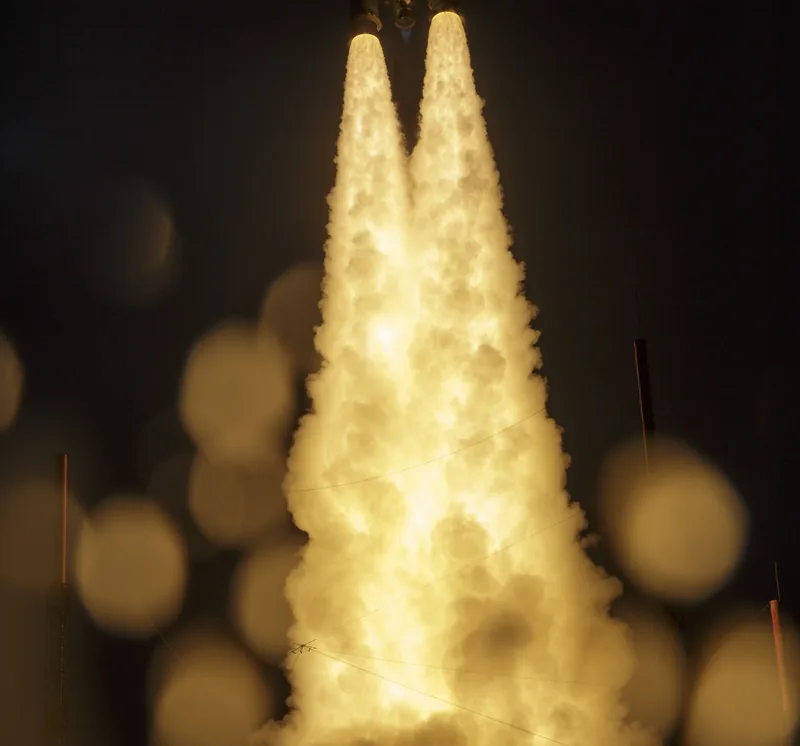
The James Webb Space Telescope left Earth on 25 December 2021. The fact sheet writes the moment as “December 25, 2021 07:20am EST (2021-12-25 12:20 GMT/UTC)” and names the vehicle “Ariane 5 ECA.”[source] Other official pages write 7:20 AM ET, or 7:20 AM, and 12:20 UTC or 12:20 UT. The date is not in doubt.
Christmas morning, from Kourou
The launch page says Webb “was launched from Arianespace's ELA-3 launch complex at Europe's Spaceport located near Kourou, French Guiana.”[source] A caption on the same page writes: “On December 25, 2021, and 7:20 AM ET (12:20 UTC), the James Webb Space Telescope was launched by an ArianeSpace Ariane 5 rocket from Europe's Spaceport.”[source] The FAQs say “an Arianespace Ariane 5 ECA rocket,” and that “the launch vehicle and launch site were part of the European Space Agency's contribution to the mission.”[source] Official spellings of the rocket’s family — Ariane 5, Ariane 5 ECA, Arianespace, ArianeSpace — are left as each page wrote them.
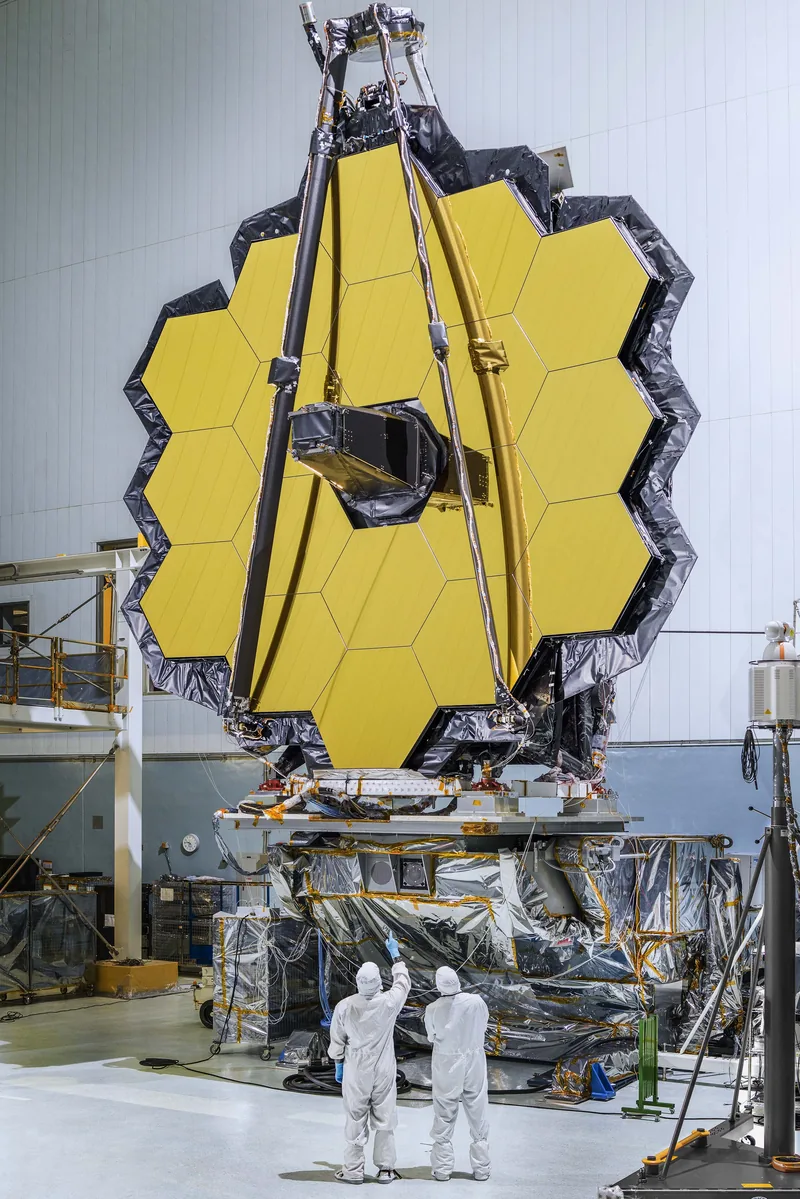
The fact sheet’s key facts call the design a folding one: “So big it had to fold origami-style to fit in the rocket and unfolded like a “Transformer” in space.”[source]
Eighteen hexagons
The same sheet is unusually exact about the mirror. Diameter of the primary: “6.5 m (21.3 ft) approximately.” Clear aperture: 25 m². Material: “beryllium coated with gold.” Mass of the primary: 705 kg. A single beryllium mirror: 20.1 kg; “39.48 kg for one entire primary mirror segment assembly (PMSA).” Focal length: 131.4 metres. Number of primary mirror segments: 18. Optical resolution: “~0.1 arc-seconds.” Wavelength coverage: 0.6–28.5 microns.[source]
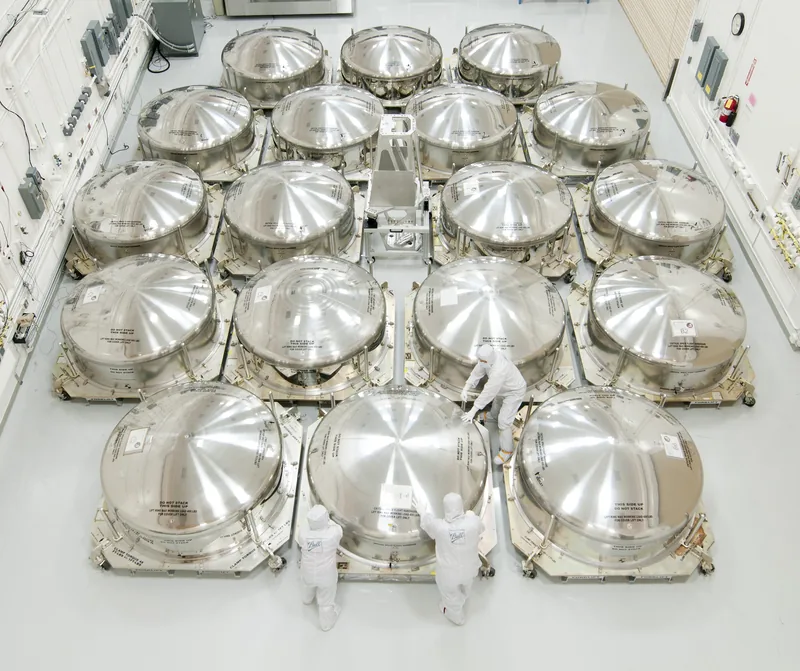
How much gold is on those segments? The fact sheet does the arithmetic in public. Thickness of the gold coating: “100 × 10⁻⁹ metres (1000 angstroms).” Surface area: 25 m². Using the density of gold at room temperature, 19.3 g/cm³, “the coating is calculated to use 48.25g of gold, about equal to the mass of a golf ball.” Then the note that makes the comparison honest: “A golf ball has a mass of 45.9 grams. Note mass does not equal size!”[source]
A sunshade the size of a tennis court
“Webb has a 5-layer sunshield that protects the telescope from the infrared radiation of the Sun, Earth, and Moon; like having sun protection of SPF 1 million,” the fact sheet says.[source] Size of the sun shield: 21.197 m by 14.162 m (69.5 ft by 46.5 ft). Operating temperature: “under 50 K (-370 °F).” Payload mass is given as “Approx 6200 kg, including observatory, on-orbit consumables and launch vehicle adaptor.” Mission duration, on that sheet, is written “5 - 10 years.”[source]
After launch, the launch page says, “the telescope deployed on its 29-day, million-mile journey out to the second Lagrange point (L2).”[source] The fact sheet writes the orbit as “1.5 million km from Earth orbiting the L2 Point.”[source] The FAQs add that all major deployments were completed on 8 January 2022, and that “the Webb Observatory will not reside precisely at the L2 point but will slowly rotate around it twice per year in a loop that is even bigger than the Moon’s orbit around the Earth.”[source]
What is it for? The fact sheet’s opening says Webb is “an orbiting infrared observatory that will complement and extend the discoveries of the Hubble Space Telescope, with longer wavelength coverage and greatly improved sensitivity.” The longer wavelengths, it says, “enable Webb to look much closer to the beginning of time and to hunt for the unobserved formation of the first galaxies, as well as to look inside dust clouds where stars and planetary systems are forming today.”[source] The same sheet’s “Unprecedented Sensitivity” line says Webb can “peer back in time over 13.5 billion years to see the first galaxies born after the Big Bang.”[source]
The instruments on that sheet are the Near Infrared Camera (NIRCam), the Near Infrared Spectrograph (NIRSpec), the Mid Infrared Instrument (MIRI), and the Fine Guidance Sensors / Near Infrared Imager and Slitless Spectrograph (FGS/NIRISS). MIRI, the sheet says, “carries detectors that need to be at a temperature of less than 7 kelvin to operate properly.” That temperature “is not possible on Webb by passive means alone, so Webb carries an innovative “cryocooler” that is dedicated to cooling the MIRI detectors.”[source]
The ride up was brief. The FAQs say “The Ariane 5 launch vehicle provided thrust for roughly 26 minutes after a morning liftoff from French Guiana,” and that “Ariane sent Webb on a direct route to L2, without first orbiting Earth.”[source]
Enjoyed this space-telescope desk?
No pop-ups. No intrusive advertising. Just interesting stuff. A little support helps the next galaxies.im site get built.